
Bishop Martin Church of England Primary School

English
At Bishop Martin CE Primary School our Guiding LIGHT Curriculum is built around the National Curriculum, enriched to reflect the children and community we teach.
We strive to provide a curriculum that is underpinned by our Christian Values, which are embedded in the life and work of our school, and to allow all our children to 'Let their Light Shine'.
Let Your Light Shine Before Others So They May See Your Good Deeds' (Matthew 5.16)
Our Vision
At Bishop Martin CE Primary School, we believe that language opens doors. Through reading, writing and oracy, we want every child to develop the knowledge, confidence and skills to understand the world around them, express their ideas and communicate with purpose.
We aim to nurture children who read with fluency, understanding and enjoyment; who write with confidence, accuracy and creativity; and who can articulate their thoughts, listen to others and contribute meaningfully to discussion.
At the heart of our English curriculum are strong foundations. Through explicit, carefully sequenced teaching of early language, phonics, reading, handwriting, spelling, vocabulary and writing, we ensure that children build the knowledge and skills they need to succeed across the curriculum and beyond.
We want every child to leave Bishop Martin seeing themselves as a reader, writer and confident communicator.
Intent
At Bishop Martin CE Primary School, our English curriculum is designed to develop confident readers, writers and communicators. We place strong foundations at the heart of our curriculum, with a particular focus on spoken language, vocabulary, phonics, reading fluency, handwriting, spelling and sentence construction. These essential skills enable children to access increasingly ambitious learning as they progress through school.
Through high-quality texts, explicit teaching and carefully sequenced learning, children develop the knowledge and skills to read with fluency and understanding, write accurately and purposefully, and communicate their ideas with confidence.
Our curriculum is ambitious and inclusive. Teaching is adapted to ensure that all children, including those with SEND and gaps in prior learning, can access the curriculum, make progress and experience success
Implementation
Our English curriculum is carefully sequenced from the earliest stages of language development through to Year 6. Teaching is explicit, progressive and responsive to children's needs, with opportunities to revisit, practise and apply key knowledge and skills.
Our approach brings together Reading, Writing, Oracy, Spelling and Handwriting, ensuring that these areas complement one another and support children to become confident and independent communicators.
Reading
At Bishop Martin, our approach to reading is built around three interconnected strands:
Learning to Read
Children develop the foundations of reading from the very beginning through stories, songs, rhymes and language-rich experiences that develop communication, listening and phonological awareness.
In Reception and Key Stage 1, we teach early reading through Read Write Inc. Phonics, a systematic synthetic phonics programme. Children are taught to recognise sounds, blend these sounds to read words and develop increasing accuracy and fluency. Children read books that are closely matched to the sounds they have been taught, allowing them to practise their developing skills successfully.
Children are assessed regularly and grouped according to their current reading stage, ensuring that teaching is closely matched to what they need to learn next. Children who need additional support receive extra practice and 1:1 tutoring so that gaps are identified and addressed quickly.
In Year 2, children who still require phonics teaching continue with Read Write Inc. at the level appropriate to their needs. Children who have completed the phonics programme progress to Read Write Inc. Comprehension, alongside whole-class reading through Ready Steady Read Together.
In Key Stage 2, pupils who continue to have gaps in their phonic knowledge and decoding skills receive targeted intervention. Older pupils access Read Write Inc. Fresh Start, providing age-appropriate phonics teaching to develop reading accuracy, fluency and comprehension. Where appropriate for pupils with SEND, Read Write Inc. Phonics and 1:1 tutoring may continue to provide the smaller steps and additional practice they need.
Reading to Learn
From Year 2, all children access Ready Steady Read Together, developing fluency, vocabulary and comprehension through high-quality fiction, non-fiction and poetry. Children who still require phonics continue with Read Write Inc., while those who have completed the programme access Read Write Inc. Comprehension alongside whole-class reading.
Reading for Pleasure
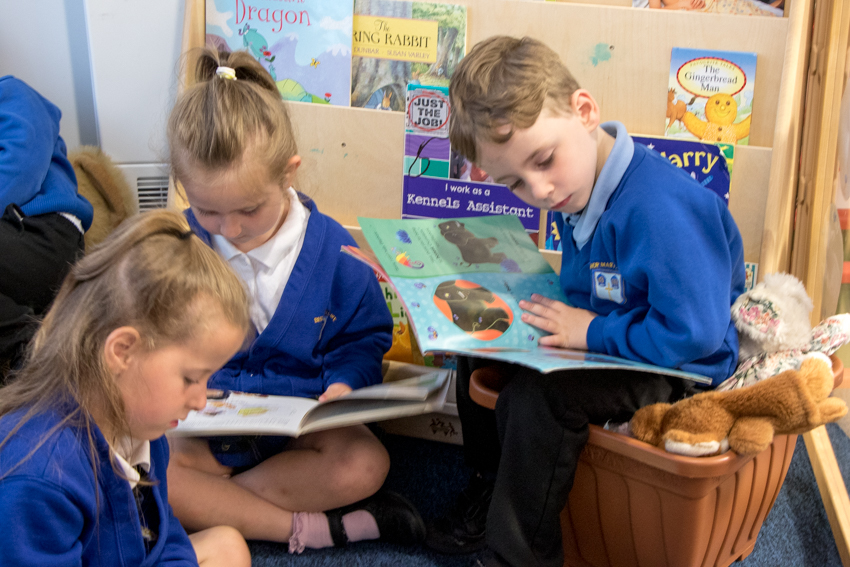
We want children to develop a genuine love of books. Children enjoy protected time to hear high-quality texts read aloud, explore a wide range of authors and genres, talk about books and develop their own reading preferences.
Writing
At Bishop Martin, we want children to become confident, purposeful and independent writers who can communicate their ideas effectively for a range of audiences and purposes.
We use Ready Steady Write to provide a carefully sequenced writing curriculum built around high-quality texts. Through explicit teaching, modelling and oral rehearsal, children progressively develop their vocabulary, sentence construction, grammar, punctuation and composition.
Children are supported to move from spoken ideas to successful written outcomes through our consistent writing process:
Say it → Rehearse it → Write it → Read it → Check it
Teaching is adapted to enable all children to participate successfully, while maintaining ambitious expectations and supporting children to develop increasing accuracy, stamina and independence as writers.
Spelling
At Bishop Martin, spelling is taught explicitly and progressively so that children develop the knowledge and strategies needed to become increasingly accurate and independent spellers.
In Reception and Year 1, spelling is closely linked to Read Write Inc. Phonics, where children learn to segment words into sounds and represent these using the graphemes they have been taught.
From Year 2 onwards, we use Ready Steady Spell to provide a carefully sequenced approach to spelling. Children explore spelling patterns and rules, develop their understanding of morphology and word families, and learn the statutory words appropriate to their year group.
Previously taught spelling knowledge is regularly revisited and children are expected to apply their learning within their independent writing across the curriculum.
Handwriting
At Bishop Martin, we recognise that fluent, legible handwriting is an essential foundation for successful writing. Handwriting is taught explicitly and progressively, with high expectations for presentation reinforced across the curriculum.
We follow the Read Write Inc. Handwriting approach, using Letter Village to provide children with a consistent and memorable approach to letter formation. Children develop secure letter formation before progressing to accurate joins and, ultimately, a fluent and efficient handwriting style.
Teaching focusses on correct formation, size and orientation, spacing, appropriate joins, pencil grip and posture. Regular practice enables these skills to become increasingly automatic, allowing children to concentrate on the composition and content of their writing.
Children are encouraged to take pride in their work and apply the handwriting expectations taught during dedicated sessions whenever they write across the curriculum.
Oracy
At Bishop Martin, we recognise that spoken language is fundamental to learning. Children need opportunities to develop their vocabulary, articulate their thinking, listen to others and communicate with increasing confidence.
Oracy is an area of ongoing development within our curriculum. We are currently working to strengthen and develop a consistent whole-school approach to the teaching and use of spoken language across all subjects.
Children already experience regular opportunities to rehearse ideas aloud, discuss their learning, explain their thinking, listen and respond to others and learn and use new vocabulary. Approaches such as My Turn, Your Turn, oral rehearsal and structured discussion support children to develop their spoken language alongside their reading and writing.
As our approach develops, we will continue to build upon this practice to ensure that children are progressively taught the skills they need to become confident, thoughtful and effective communicators.
Impact
At Bishop Martin, the impact of our English curriculum is seen in children who grow in confidence as readers, writers and communicators. From their earliest experiences of stories, language and phonics, children build the knowledge and skills they need to access the wider curriculum and express themselves effectively.
Through systematic phonics teaching, regular reading and exposure to high-quality texts, children develop increasing fluency, comprehension and a love of reading. Pupils who require additional support are identified quickly and receive targeted teaching to help them keep up and make progress.
In writing, children develop the confidence and skills to communicate for a range of purposes and audiences. They learn to draw upon rich vocabulary, increasingly secure spelling, grammar and handwriting, and the features of different forms of writing to create purposeful and increasingly independent pieces.
Oracy is woven throughout our English curriculum, enabling children to develop their vocabulary, articulate their ideas, listen and respond to others, and rehearse their thinking before committing ideas to writing.
We regularly assess and review pupils' learning so that gaps are identified and addressed. Our aim is for every child, including those with SEND and those who may experience barriers to learning, to make meaningful progress from their individual starting points and leave Bishop Martin equipped with the reading, writing and communication skills they need for the next stage of their education and beyond.